


Deck of Divinity: Slot Overview
One of the many methods of slot design a software provider may choose is the scattergun approach, blasting out as many games as physically possible in the hope that some of it sticks as it slides down the wall. The opposite approach is taking time on each and every release to first come up with an original concept, then expending the required amount of effort to nail each detail just so. At a guess, developer Print Studios sits firmly in the latter camp. Today's review is a textbook example of the studio pulling a clever idea out of its brain box, then bringing it to exquisite life on the reels. Titled Deck of Divinity, it follows in the footsteps of Deck of Scurra, while shuffling the cards into a scatter-pays slot with prize reveal mechanics.
Deck of Scurra was a handsome game, and Deck of Divinity is every bit as pleasing to the eye. In some ways, it's played on an even larger scale, with a focus that pans up from the playing table to the grand sweep of the cosmos. Beyond, even, moving past the atoms and molecules which form the building blocks of what we can touch, taste, and feel, to the deeper sparks animating it all. It's not a game that overwhelms the eye and ears as such, but each aspect has been tastefully designed to create sensations hinting at transcendence, as if by adjusting the dials on a telescope we can reveal the secrets hidden behind the veil. Apt, actually, for Deck of Divinity is a game of revealing Prize Cards, causing thematic elements to harmoniously mirror the mechanics.

On the Earthly side of things now, winning combinations are created when at least 5 matching regular symbols land in any position on the grid. The winning symbols vanish, and new cards are dealt to the gaps, repeating until no new win appears. This occurs on a 5x4 playing grid, fuelled by a highly volatile math model. The RTP is 96.22%, and players are able to wager $/€0.10 to $/€50 per spin, or deal. Furthermore, pressing the Deck icon opens a menu that lets users choose different card backs when certain win thresholds have been triggered.
Deck of Divinity moves away from playing cards as its symbols to what it calls symbol cards, made up of Bear, Fish, Lion, Deer, and Ouroboros lower-paying cards, then come Earth, Moon, Sun, Stars, and Aether cards. The largest winning combinations are 9+ OAK in size, and they pay 1x for the lows or 1.6x-10x for the premiums.
Deck of Divinity: Slot Features
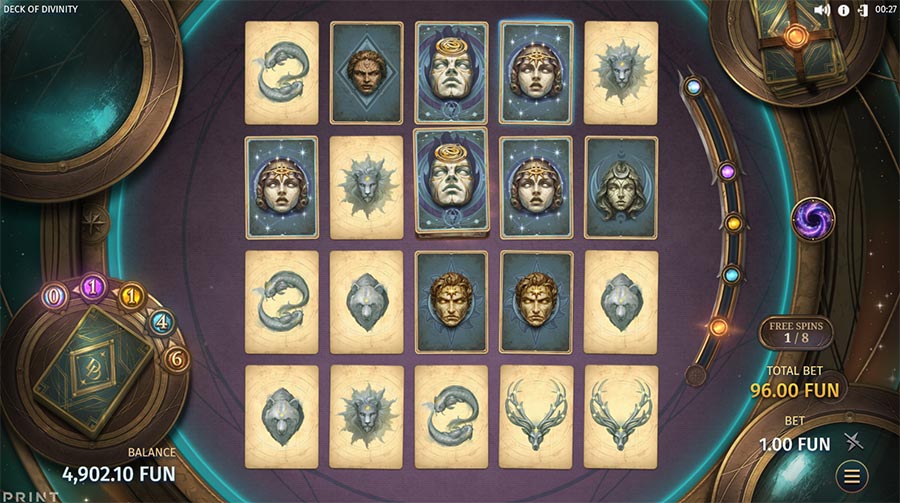
Deck of Divinity diverges quite sharply from Deck of Scurra when it comes to features, delivering Prize Cards, a Divine Deck Bonus, and feature buys.
Prize Cards
If a Prize Card is dealt, a new card gets dealt on top of it. When symbol cards are removed after a win, all Prize Cards that get revealed award the value shown on the card. Prize Cards are divided into 5 divinities, of which each divinity has 5 tiers. Earth is worth 0.5x-2,000x, Moon is worth 1x-3,000x, Sun is worth 2x-5,000x, Stars is worth 3x-7,000x, and Aether is worth 5x-10,000x.
Divine Deck Bonus
Landing 3 or 4 bonus card scatters awards 8 or 10 free spins, respectively, while 5 landed bonus card scatters award 10 free spins and a guaranteed Hidden Prize Card on every grid position each spin. Bonus card scatters only appear in the base game. During the Divine Deck Bonus, Prize Cards placed on the grid return to the deck after they have paid or when the spin ends. In addition, awarded Prize Cards of tier 4 or lower are upgraded to the next tier before they are returned to the deck. The current Prize Card count of each tier is shown next to the deck.
Before the first spin, a starting Card Pack adds 12 Prize Cards to the deck. A progress meter is displayed next to the reels, counting all winning symbol cards. When it reaches a new tier, the respective Card Pack is opened, adding 3, 5, 7, 9, or 12 Prize Cards and awarding 2, 2, 3, 3, or 5 extra free spins at tier 1, 2, 3, 4, and 5, respectively. Card Packs are more likely to have Prize Cards from their tier.
Before every spin, Hidden Prize Cards appear in 1 to 5 positions. When a Hidden Prize Card is revealed, it transforms into a regular Prize Card and is added to the deck. If the bonus round was triggered by 5 bonus card scatters, Hidden Prize Cards appear in all 20 positions on each spin.
Feature Bets
Adjusting the SuperSlider increases the chance of triggering the Divine Deck Bonus, costing from 1.5x to 95x the base stake. Otherwise, paying 96x the bet buys into the Divine Deck Bonus.

Deck of Divinity: Slot Verdict
Whilst the second time around might lessen some of the impact, like its sibling, Deck of Divinity oozes sophistication. It's done away with playing cards displaying numbers and ranks, in favour of straight picture cards, but it remains an elegant conjunction of card and slot. Thematically touching on the universe and what makes it tick expands the cerebral quality, further cementing Print Studios' status as the thinking gambler's developer, as its products blur the lines between slot and art. Interestingly, Deck of Divinity achieves this not by bombarding the player with an audiovisual overload, but by dropping intellectual crumbs and what ifs here and there, for the imagination to grasp.
At the risk of opening a can of worms, Deck of Divinity did come across as the slightly less sophisticated experience of the two games, mechanically speaking, though not in an overly negative way. Wrapping your head around Prize Card reveals is arguably easier than getting to grips with Deck of Scurra's Alteration Card system. Simply reveal a Prize Card from beneath a winning symbol card, and boom, the dough is yours. That might possibly be a slight disappointment for fans of the original, though the Divine Deck Bonus does ratchet up the complexity. Progress is the name of the bonus game, and unfolds in a couple of ways. One, by collecting enough winning symbol cards to progress through tiers, which adds extra free spins and Prize Cards. The other is by upgrading winning, lower-tier Prize Cards. It's a combination that can meander if not much is going on, or possibly explode when the cards are hitting in all the right places.
It is difficult to say with complete conviction whether Divine of Divinity is better or worse than its predecessor. Both games do some great stuff, from eye-tickling artwork to intelligent gameplay while pulling players in different directions. Some gamblers may prefer the immediate, hard and fast, hit-or-miss Prize Card reveals while others may cleave loyally to the previous game, like a winning hand they are reluctant to fold. Either way, choice can be a fine thing, and at the end of the day, Divine of Divinity is another clever idea, neatly packaged.
Deck of Divinity is another polished and distinctive release from Print Studios, though whether it surpasses Deck of Scurra will largely come down to personal preference.


